
Collection of five documents dating from 9 June 1965 through 1966 pertaining to potential means to provide access into Mineral King.
Research Database
Documents pertaining to Mineral King access
Title
Documents pertaining to Mineral King access
Item ID
2013.10.31.002
Type
document
Period
1965-06-09 through 1966
Creator
Hicks, Robert B.; Cottrell, William; unknown
Location
Mineral King Preservation Society
Extent
9 8.5 x 11 in. pages
Places Referenced
Mineral King; Mammoth Mountain; Zurmatt, Switzerland
People Referenced
Broggie, Roger E.; Clark, Royal "Mickey"; Cochrane, Frederick; Disney, Walter Elias; Hicks, Robert B.; Hummel, Edward A.; Ladd, Thornton; Miller, Ronald William; Price, Harrison A. "Buzz"; Riley, Jack; Vilmer, Earl
Occupations Referenced
Events Referenced
Other References
road; tunnel; cog railroad
Description
This is a collection of five documents pertaining to access into Mineral King. The documents were bound together with two brads.
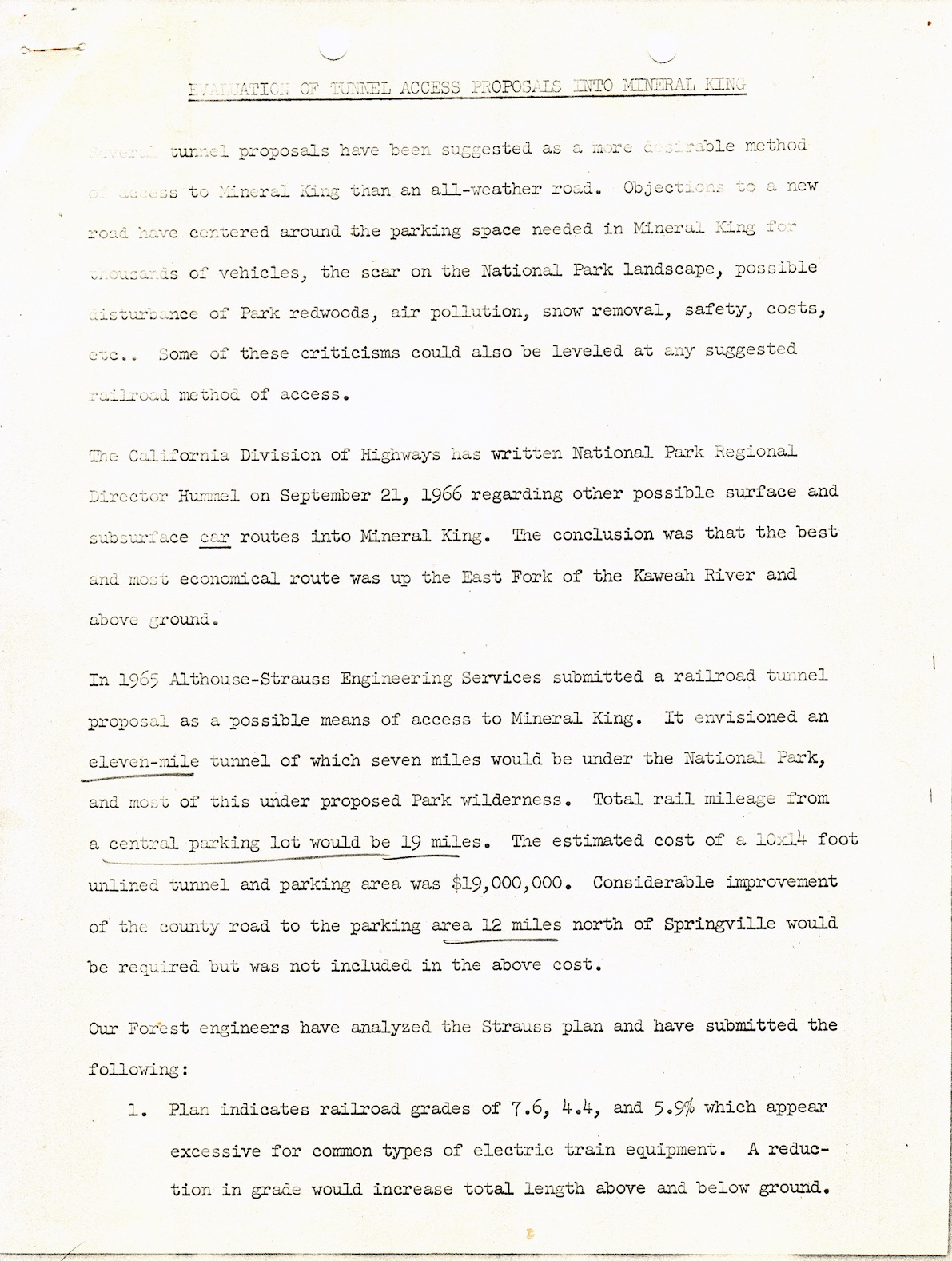
- 'Evaluation of Tunnel Access Proposals into Mineral King'. Author unknown. Date unknown. This is a typed two-page document that references a 21 September 1966 letter from National Park Regional Director Edward A. Hummel and a 1965 proposal by Althouse-Strauss Engineering Services. The author opposes a tunnel and advocates a surface road up the East Fork of the Kaweah River.
- Untitled. Author unknown. Date unknown. This is a typed one-page document that proposes the use of two or three trains that would carry 2400 passengers per hour.
- This is a one-page typed inter-office communication sent from William Dennis Cottrell to "Those Concerned" with Harrison A. "Buzz" Price, Robert B. Hicks, Thornton Ladd, Roger E. Broggie, and Royal "Mickey" Clark, cc'd on 10 June 1965. It states that all inquiries related to cog railway systems should be directed to Broggie and requesting information concerning functions, requirements, capacity, styling, length of track, grades, and weather conditions. This information is provided below in a handwritten note.
- This is a three-page typed memo sent from Robert B. Hicks to Walter Elias Disney, Ronald William Miller, Royal "Mickey" Clark, Harrison A. "Buzz" Price, Thornton Ladd, and Frederick Cochrane on 9 June 1965. The subject is "Mineral King Submission - Discussion with Peter Hirsbrunner, an engineer from the Von Roll Company, in Jack Riley's Office at Disneyland on May 20, 1965, and with Earl Vilmer on the relative merits of various mechanized transportation systems to be considered in the development plan for Mineral King." The document pertains to ski resort developments not accessible by vehicle and discusses gondola, monorail, and train forms of mechanized transportation
- 'Mammoth Mountain Ski Site Access Rode'. Author unknown. Date unknown. This is a two-page typed document that summarizes data derived from Mammoth Mountain to present the potential problems that could be associated with vehicular access to Mineral King in the winter.
Background
Transporting thousands of visitors to and from Mineral King each day posed a logistical, technological, and monetary challenge. The valley was served by a steep, winding county road that was one-lane much of the way. It traversed unstable terrain that presented a risk of catastrophic failure and giant sequoias that had to be protected. Portions were subject to deep snow drifts and avalanche The U.S. Forest Service recognized the costs and challenges of developing a viable transportation system and researched alternatives to vehicular access before it approved Disney's proposal. As evidenced by this packet of documents, Disney considered multiple alternatives while developing its proposal, and it continued to explore options during subsequent development of the master plan.
Transcriptions
2013.10.31.002.001.a
EVALUATION OF TUNNEL ACCESS PROPOSALS INTO MINERAL KING
Several tunnel proposals have "been suggested as a more a more desirable method of access to Mineral King than an all-weather road. Objections to a new road have centered around the parking space needed in Minerals King for thousands of vehicles, the scar on the National Park landscape, possible disturbance of Park redwoods, air pollution, snow removal, safety, costs, etc.. Some of these criticisms could also be leveled at any suggested railroad method of access.
The California Division of Highways has written National Park Regional Director Hummel on September 21, 1966 regarding other possible surface and subsurface car routes into Mineral King. The conclusion was that the best and most economical route was up the East Fork of the Kaweah River and above ground.
In I965 Althouse-Strauss Engineering Services submitted a railroad tunnel proposal as a possible means of access to Mineral King. It envisioned an eleven-mile tunnel of which seven miles would be under the National Park, and most of this under proposed Park wilderness. Total rail mileage from a central parking lot would be 19 miles. The estimated cost of a 10x14 foot unlined tunnel and parking area was $19,000,000. Considerable improvement of the county road to the parking area 12 miles north of Springville would be required but was not included in the above cost.
Our Forest engineers have analyzed the Strauss plan and have submitted the following:
1. Plan indicates railroad grades of 7.6, 4.4, and 5.9% which appear excessive for common types of electric train equipment. A reduction in grade would increase total length above and below ground.
2013.10.31.002.001.b
2. No addits feasible, so tailings must be hauled one way, requiring a dumping ground for 400,000 cu. yds, - an eyesore somewhere.
3. Snow removal requirements at both ends of tunnel not covered in plan. There would be at least 10 miles of above-ground railroad, the construction of which would disturb the ground about as much as a two-lane road.
4. Overbreak and tunnel lining are minor considerations in the Strauss report. Yet the requirements of both could easily double the estimated cost of the tunnel.
5. Strauss suggests a minimum round trip price of $3.00 Per person. For the average family this additional trip cost of about $12.00 could easily cancel thoughts of visiting Mineral King. There is no scenery to enjoy in a tunnel.
Americans are car oriented. One of the largest recreation pursuits is pleasure driving and sightseeing. Americans much prefer to drive their cars to a recreation site than leave their car miles away and pay additional monies for another type of transportation. The proposed parking lot at Mineral King, built in tiers and probably double-decked some day, will require only a part of one percent of the total Mineral King acreage.
There is always the lurking thought of a small city, such as Mineral King would become, dependent in winter entirely on a long tunnel, being isolated by some tunnel disaster - a major wreck, power failure, or earthquake. Roads are relatively easy to keep clear.
2013.10.31.002.002
Three (3) 100 Ton, 1,000 H. P trains will carry 2400 Passengers per hour one way or two (2) 175 ton, 1500 H.P. trains
Track length: 1.5 miles
Maximum Grade: 9%
Passenger/Train weight: 5:1 © 175 lb Passenger & Baggage
Average speed: 18 M.P.H.
Trip time: 5 minutes minimum
Stop time: 5 minutes maximum
Trips per hour: 6 departures /2 trains
Train capacity: 400 passengers /2 trains
Maximum trips per hour: 10 departures /3 trains
Train capacity: 240 passengers /3 trains
Minimum train weight: 210,000 lbs.
Maximum train weight: 350,000 lbs.
Minimum train H.P.: 910 H.P. (Net, no drag)
Maximum train H.P.: 1510 H.P.(Net, no drag)
@ 10 departures per hour with 3 trains, each train would stop at the main station every third departure or every 18 minutes. If it stopped for 5 minutes at each of two stations, then its running time for one 3 mile round trip would be 8 minutes averaging 22.5 M.P.H. But this is impossible! So the stop time @ each station must be 4 minutes (to unload 240 passengers and reload) and running time 5 minutes with 2 minutes between the time a train leaves and the next one arrives. Thus the trip running time is 10 minutes for 3 miles or 18 M.P.H. Two (2) trains could stop for 7 minutes to load. The train could accelerate @ 2 M.P.H.2 to about 20 M.P.H. then slow to 16 to 18 M.P.H. on the steepest grades and average 18 M.P.H.
2013.10.31.002.003
RETLAW ENTERPRISES
INTEROFFICE COMMUNICATION
TO: Those Concerned
FROM: Bill Cottrell
DATE: June 10, 1965
SUBJECT: Project MK
Regarding the train system to be used in Project MK, you are herewith requested to directany inquiries re. Cog Railway systems to Roger Broggie, Chief Engineer of Walt Disney Productions' Machine Shop. (Victoria 9-3411 or Thornwall 5-3141 - Extension 248[?].
Roger has been advised of our interest in researching a transportation system for handling people, luggage and freight in mountain areas.
He will need information from your offices regarding:
1. The trains functions, requirements , capacity and design styling.
2. Length of track, grades, weather conditions, etc.
cc:
Buzz Price / Bob Hicks (ERA]
Thornton Ladd (Ladd & Kelsey, Architects)
Roger Broggie
Mickey Clark
[the following is hand written]
8 trains/hr 12 1/2 mile interval
track - 3 mile circuit
grade - 6 1/2% max
capacity - 2400 lbs. max. with skis & baggage
weather extremes -3° F to 80°
Snow avg fall 6 feet
2013.10.31.002.004.a
June 9, 1965
MEMORANDUM
TO: Walt Disney
Ron Miller
Royal Clark
Harrison A. Price
Thornton L a d d
Fred Cochrane
FROM: Robert B. H i c k s
SUBJECT: Mineral King Submission - Discussion with Peter Hirsbrunner, an engineer from the Von Roll Company, in Jack Riley's Office at Disneyland on May 20, 1965, and with Earl Vilmer on the relative merits of various mechanized transportation systems to be considered in the development plan for Mineral King.
As a n example o f a ski resort development accessible only by train, Mr. Hirsbrunner described Zurmatt, Switzerland, where the highway ends at a small village with 2 or 3 small hotels in a valley some 20 miles below Zurmatt. Approximately 1,000 autos can be parked at the train station. The train to Zurmatt is an electric overhead trolley which is rail for half distance and cog the balance of the distance where the grade is in excess of 5 per cent. The cost for the one and one-half hour one-way trip to Zurmatt is 25 Swiss francs, or approximately $5.50.
At Zurmatt there are approximately 80 tourist beds; the permanent population i s 1,500 to 3,500 people , and in the winter time the population reaches 10,00 people. Wintertime trains depart as often as 5 minute intervals. The normal summer schedule is one and one-half hours between trains. There is only one track and trains must pass at one of several stations along the way. Transportation in the summer is provided by horsedrawn vehicles, and in the winter by sleighs. Supplies are hauled on electric trucks. The village is located in a valley similar to that of Mineral King, approximately one-quarter mile wide and one mile long. Zurmatt has local hydro-electric power plants for part of its needs plus an electric transmission line into the village.
With t h e increased number of automobiles, there is now pressure for continuing the road to a flat area within 2 o r 3 miles below Zurmatt where
parking can be provided and the train boarded for the trip on into Zurmatt. There has also been consideration given recently in Zurmatt to connect the
village with each ski lift by a small monorail such as was used at the
2013.10.31.002.004.b
Lausanne Fair last Fall. This was an all steel supported monorail with a capacity of 5,000 people per hour. In the peak day fo the Fair, 35,000 people were transported by the monorail. It was approximately 2 miles long with intervals between trains of 3 to 4 minutes at the peak. The cars were approximately one-half as big as those at the Disneyland monorail. The same monorail is to be built at the Montreal Worlds Fair in 1967 by Habogger of Thun, Switzerland.
Another example of a ski resort with no automobiles is located near Zurmatt at Seas Fee where automobiles can drive to within one-half mile of the village and then ark in a flat area. Horsedrawn sleighs take the people the quarter to half mile to the village which is approximately one-half mile long.
The three types of mechanized transportation talked about in this discussion are:
1. A sky ride or gondolar type transportation.
2. Monorail.
3. Train
The advantages of a train or monorail over a sky rider are: 1) the track can turn in any direction; 2) maintenance problems and operating costs are less; 3) greater capacity; 4) comfortable in winter weather; 5) a variety of mechanized transportation is provided since the ski lifts would be of the sky ride or gondola type.
High construction and capital equipment cost would be the major disadvantage with a monorail. The cost for the Disneyland monorail was $1 million per mile with car costs additional. All steel construction would be less but terrain problems may increase the cost over that at Disneyland.
The only advantage of a gondola car or sky ride type would be the lower installation and initial construction cost. However, capacity is quite limited since a continuous system cannot be used for more than 4 persons per car, resulting in a maximum capacity of 1,200 people per hour if a car is loaded each 12 seconds. This would be impossible to attain as skis and baggage would have to be loaded on to the car. A larger gondola system would not be continuous. A maximum speed for even the small 4 passenger car is 10 feet per second requiring 10 to 12 minutes per mile. Passenger comfort is a problem in cold weather. A gondola car must travel in a straight line unless there ar special stations for turning and the passengers must ride from one end of the line to the other. Intermediate stations are very expensive to build and normally 4 employees are required at each station to load and unload with 3 employees at each intermediate station.
A train may be the most practical and economical for Mineral King. Since the grade on the valley floor at Mineral King will average less than 5 per cent ordinary track can be used. Over 5 per cent a cog drive is needed as at Zurmatt and over 10 per cent grade requires a funicular type such as Angels Flight. Narrow 36 inch track costs are approximately $8.00 per foot for level terrain. Grading would be additional. Engines may
2013.10.31.002.004.c
cost $40,000 to build but diesels would be less expensive.
A t Disneyland 6 cars can carry 300 to 350 persons at 10 to 12 miles per hour. Trip time for the 2 1/4 mile round trip i s 15 minutes (12 minutes running time plus 3 minutes for loading and unloading).
Further study is needed on the following:
1. Capacity requirements for peak periods.
2. Length of the transportation system - this depends upon where the all weather highway ends - at Silver City, at Faculty Flats just outside the Mineral King valley entrance, or at
the upper end of the valley.
3. The effect on transportation requirements of early development of Mosquito Bowl and the adjoining slopes to the west down to the Kaweah River
2013.10.31.002.005.a
MAMMOTH MOUNTAIN SKI SITE ACCESS ROAD
The Mammoth Mountain Ski site is one of the most popular in California. Most of the skiers from Southern California as will be the case at Mineral King. Mammoth is reached by a five-mile,24-foot wide, two-lane road from Mammoth Lakes village. Traffic experiences on the Mammoth road may be compared with what can be expected on.a two-lane road to Mineral King; btut recognizing the Mineral King road will be slightly less steep and better aligned, perhaps a little wider, but considerably longer.
Traffic counts and problems have been documented for some years at Mammoth. Peak days are considered as those when over 900 cars ascend the road. The number of peak days during the last four winters are:
62-63 6 days
63-64 12 days
64-65 18 days
65-66 40 days
Monthly usage has exceeded 20,000 cars. A monthly average for last season, from mid-November through April 1, is 18,000 cars per month.
There have been many accidents and traffic tie-ups on this short stretch of road in winter. Mammoth, on a peak day, when snow is on the five-mile road from the Village to the lifts will experience three to five accidents a night; normally occurring when the traffic is going downhill. Accidents have been observed as high as 14 in one night in a two-hour period. The accidents are usually not serious, as the road has no drop-offs, and the banks are generally quite high. The situation will be greatly improved soon by construction of a loop road allowing one-way traffic on two lanes.
2013.10.31.002.005.b
A narrow winter road with a sustained grade at high elevations, accommodating heavy traffic, can present some of the following problems as experienced at Mammoth:
1. If a tire chain breaks the driver will pull to the side. Cars trying to pass conflict with oncoming traffic.
2. Most California drivers are not familiar with snow and ice, thus causing multi-car accidents by following too closely with no room to maneuver on a slick narrow road.
3. Snow country curves often are not "supered", due to the need for flat turns so snow plows won't slide sideways while plowing at slow speeds.
4. Narrow roads tend to panic traffic coming from the opposite direction when the drivers meet wide snow removal equipment.
5. A wide road provides additional snow storage space until rotary plows can blow the snow away. Deep cuts present a unique snow removal problem.
6. If a vehicle is abandoned on a road during a storm, plows must swing wide, drifts build up and out, causing considerable road encroachment and accidents.
We wish to emphasize the similarity between an existing and proposed winter recreation access road to show the need for (adequate) width for public safety and driving enjoyment.